The healthcare industry is making significant progress on technical interoperability, but we continue to fall short of the promise of true health information exchange. Until we can consistently send and receive accurate and useful patient data nationwide, we will fail to realize the documented benefits of well-executed health information exchanges: improvements in clinical decision making and patient safety, business process improvement, and support for value-based payment. Among the remaining challenges to successful nationwide exchange is patient matching across organizational boundaries.
The inability to consistently and accurately match patient data creates a number of problems for physicians and other healthcare providers. Providers may have an incomplete view of a patient’s medical history, care may not be well coordinated, patient records may be overlaid, unnecessary testing or improper treatment may be ordered, and patient confidence may be damaged or diminished.
In addition, providers may experience a number of clinical workflow inefficiencies that are costly. Those include prolonged troubleshooting to find the correct patient record, a reversion to manual telephone and fax information exchange workflows, waiting for a duplicate lab test order, or a manual effort to fix a patient record match.
To address these critical patient matching and identity management issues, The Sequoia Project, in collaboration with the Care Connectivity Consortium (CCC), has developed a framework for future growth and improvement that will shed light on several key topics:
Following publication of the proposed framework, The Sequoia Project convened a Patient Identity Management Workgroup, inviting members and non-members. Comprising of industry and government experts, the workgroup was charged with dispositioning public comments to develop final recommendations for improved patient identity management in a freely usable resource for the industry. Over time, it is the intent of The Sequoia Project that this document is periodically updated to capture and advance cross-organizational patient matching innovations.
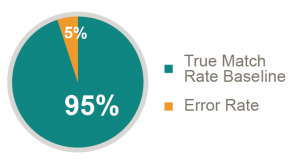
Intermountain Health Care, a CCC member, is a sophisticated healthcare provider and payer, and has invested heavily in healthcare information technology. So when they started exchanging data with other organizations, they expected a reasonably high degree of success. They surprisingly only achieved a 10% success rate in accurately matching patient records across organizational boundaries. Through algorithmic performance and refinement, and data quality analysis, Intermountain and its partners gained significant initial improvement from 10%. Human workflow and data entry issues were next inspected, with an expected improvement to 90%, but actually only resulted in an improvement to 62%.
The remaining 38% error rate was analyzed in detail and found to break down into algorithmic issues, authorization/consent issues, network and IT issues, and other errors such as inconsistent encoding. These improvements resulted in a match rate of 85%. A number of best practices were then identified and implemented resulting in successful patient match rates of over 95%. These practices include systematically working with partners, addressing patient consent issues, proactively improving “fragile” identities, and addressing human workflow issues. An analysis of common patient matching traits is presented, along with a list of rules developed during the study. These rules are further analyzed in terms of completeness and uniqueness. The result was significantly improved match rates for Intermountain and its partners, and patient matching improvement strategies that can be replicated across the industry.
At the conclusion of the case study a number of lesson’s learned and best practices are shared. There are also suggestions to improve cross-organization patient matching success to greater than 99%, which include the use of a supplemental identifier, involving the patient in the identity management process, and more. We also provide a self-diagnostic tool, in the form of a questionnaire, to jump start a self-assessment of your own patient matching strategies.
We believe that more precise definitions of the maturity model will give organizations the ability to adopt more advanced patient identity management in a methodical manner. The levels currently being contemplated in our proposed maturity model, now open to public comment, include:
Assessments are based on the International Organization for Standardization (ISO) framework, which includes people, process, and technology, with the added dimension of governance. Current traits associated with the various levels include patient identity management validation plans, community collaboration, use of standards, quality metrics, knowledge sharing, partner onboarding maturity, and more. Each of these traits is defined and mapped to appropriate maturity levels.
This proposed framework illustrates a very low-level, and concrete, list of cross-organizational patient matching practices. The target audience for this, the last section in this paper, is senior technical staff responsible for implementing clinical document care summary exchange. A number of specific rules are presented, such as the prohibition of using exact character-by-character matching, the corresponding responsibilities on both partners to an exchange of patient data, and similar practices. Other principles include not relying on any specific identifier (such as a Social Security number), not making any assumptions about the life cycle of a patient identifier, using normalized traits, and more.
Interoperability Matters a public-private cooperative solving discrete health information exchange challenges through a variety of workgroups and initiatives. Learn More
Workgroup organized to assist understanding the barriers consumers face in accessing health information.
Workgroup organized to help propose and develop strategies to meet consumer healthcare needs.
Workgroup that targets improvements necessary to enable semantic interoperability of health information.
Workgroup focused on the on-the-ground approaches to facilitate information sharing.
Workgroup Inactive Workgroup that explores and recommends methods to improve interoperability amongst payers.
Workgroup that is committed to improving pharmacy interoperability.
Workgroup focused on supporting proper information exchange that protects consumers privacy.
Community of Practice focused on providing participants with best practices at the intersection of public health.
Committee is focused on facilitating and prioritizing the work of the Interoperability Matters Workgroups.
Learn about our history and meet the team that makes The Sequoia Project unique in the healthcare industry
Meet the members that help to make up The Sequoia Project community.
Learn more about the events available to The Sequoia Project members throughout the year.
Learn more about the benefits and resources available to The Sequoia Project members.
Visit The Sequoia Project swag store to purchase branded merchandise and apparel.
Learn more about sponsorship opportunities to help advance The Sequoia Project's mission.
Help us solve healthcare interoperability by become a member of The Sequoia Project.
(Members Only Access)
Access The Sequoia Project members community area and Member Directory
TEFCA™, outlines a common set of principles, terms, and conditions to support the development of a Common Agreement that helps enable the nationwide exchange of electronic health information (EHI) across disparate health information networks (HINs).
Discover how The Sequoia Project’s Advisory Services can support your organization with tailored projects and provide expert guidance on interoperability initiatives.
Bring The Sequoia Project experts to your organization to deliver education on interoperability and Health IT, tailored to your team’s needs and goals.
Engage The Sequoia Project team to support interoperability and health IT testing initiatives.
Learn how the Data Usability Taking Root Movement is advancing healthcare interoperability by improving the quality, consistency, and usability of shared health data across the industry.
The Sequoia Project is convening privacy & consent advocates in recognition of various initiatives underway to ensure health data is exchanged with proper patient consent.
Role-based education that helps healthcare organizations understand and comply with the Information Blocking Rule established under the 21st Century Cures Act.
The Sequoia Project offers a variety of opportunities for you to promote and highlight your organization throughout the year with sponsorships. From programs to our yearly annual meeting, there are a variety of sponsorship opportunities to choose from.
Discover the latest resources for advancing interoperability in your organization
Explore our public comments on Health IT, interoperability, information sharing, TEFCA, and healthcare policy initiatives.
Share your comments on Interoperability Matters Workgroup draft publications and add your insights to open surveys.
Contact us to learn more about health data interoperability, membership, initiatives, and how to get involved.
The annual meeting is the premier gathering of healthcare leaders, policy experts, and technology innovators dedicated to advancing nationwide health data exchange.