

On July 3, 2023, the U.S. Department of Health and Human Services Office of Inspector General (HHS/OIG) finalized its rule implementing civil monetary penalties for information blocking (IB), as authorized by the 21st Century Cures Act. As of September 1, 2023, OIG may impose penalties of up to $1 million per violation on certain entities – specifically:
In a separate rule, HHS established disincentives, rather than monetary penalties, for certain healthcare providers who commit IB. These apply to specific Medicare and Medicaid program participants and can affect:

ASTP receives and reviews complaints, and can also take enforcement action against Health IT Developers of Certified Health IT through the ASTP/ONC Health IT Certification Program (e.g., corrective action plans, suspension, or termination of certification).

OIG investigates violations and enforces penalties on rule breaking entities.

CMS applies disincentives to Medicare/Medicaid providers under its programs.
Through complaints filed by individuals or entities
To prioritize cases, OIG will focus on those that:
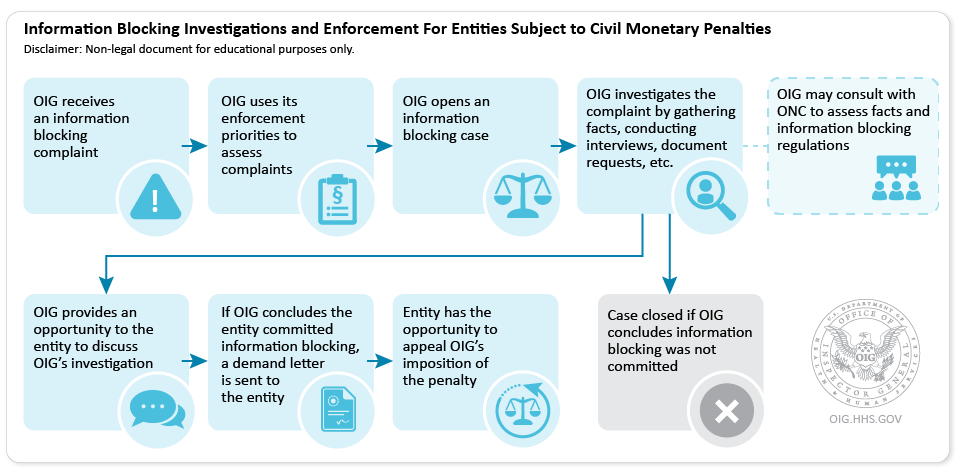
Source: OIG Website – https://oig.hhs.gov/reports/featured/information-blocking/
This resource does not constitute legal advice. Please consult with your legal counsel to determine whether the IB Rules apply to you or your organization and what compliance and enforcement might mean for you or your organization.
While enforcement is complaint-driven, OIG prioritizes investigations based on patient harm, impact to care, or willful violations. Organizations that can demonstrate a proactive compliance posture are better positioned in the event of an investigation, or to prevent violations in the first place.
Establish or update an (IB) Compliance Program that includes:
Here are some tips to ensure your organization is ready in the event of an investigation. Note that The Sequoia Project has an array of resources available that provide much more detail on strategies for IB compliance. Information Sharing Workgroup Resources – The Sequoia Project.

Gather information about the request that triggered the investigation and identify the scope of those requests (if possible)

Maintain a posture of cooperation with investigators, while documenting all interactions and an inventory of documents shared

Follow generally accepted practices for retention and maintenance of records
Not all actor types have the same capabilities for readiness and response. The following section provides more tailored tips by organization type and size.

Key Readiness Focus: Ensure enterprise-wide consistency in IB policies; centralize logging and audit capabilities.
Key Response Steps:

Key Readiness Focus: Use ASTP/ONC tip sheets and FAQs; assign a compliance lead even if part-time
Key Response Steps:

Key Readiness Focus: Align product documentation and customer agreements with IB requirements
Key Response Steps:
Links to federal websites may not be active during the Government Shutdown.
Inspection and Evaluation Peer review
Interoperability Matters a public-private cooperative solving discrete health information exchange challenges through a variety of workgroups and initiatives. Learn More
Workgroup organized to assist understanding the barriers consumers face in accessing health information.
Workgroup organized to help propose and develop strategies to meet consumer healthcare needs.
Workgroup that targets improvements necessary to enable semantic interoperability of health information.
Workgroup focused on the on-the-ground approaches to facilitate information sharing.
Workgroup Inactive Workgroup that explores and recommends methods to improve interoperability amongst payers.
Workgroup that is committed to improving pharmacy interoperability.
Workgroup focused on supporting proper information exchange that protects consumers privacy.
Community of Practice focused on providing participants with best practices at the intersection of public health.
Committee is focused on facilitating and prioritizing the work of the Interoperability Matters Workgroups.
Learn about our history and meet the team that makes The Sequoia Project unique in the healthcare industry
Meet the members that help to make up The Sequoia Project community.
Learn more about the events available to The Sequoia Project members throughout the year.
Learn more about the benefits and resources available to The Sequoia Project members.
Visit The Sequoia Project swag store to purchase branded merchandise and apparel.
Learn more about sponsorship opportunities to help advance The Sequoia Project's mission.
Help us solve healthcare interoperability by become a member of The Sequoia Project.
(Members Only Access)
Access The Sequoia Project members community area and Member Directory

TEFCA™, outlines a common set of principles, terms, and conditions to support the development of a Common Agreement that helps enable the nationwide exchange of electronic health information (EHI) across disparate health information networks (HINs).
Discover how The Sequoia Project’s Advisory Services can support your organization with tailored projects and provide expert guidance on interoperability initiatives.
Bring The Sequoia Project experts to your organization to deliver education on interoperability and Health IT, tailored to your team’s needs and goals.
Engage The Sequoia Project team to support interoperability and health IT testing initiatives.
Learn how the Data Usability Taking Root Movement is advancing healthcare interoperability by improving the quality, consistency, and usability of shared health data across the industry.
The Sequoia Project is convening privacy & consent advocates in recognition of various initiatives underway to ensure health data is exchanged with proper patient consent.
Role-based education that helps healthcare organizations understand and comply with the Information Blocking Rule established under the 21st Century Cures Act.
The Sequoia Project offers a variety of opportunities for you to promote and highlight your organization throughout the year with sponsorships. From programs to our yearly annual meeting, there are a variety of sponsorship opportunities to choose from.
Discover the latest resources for advancing interoperability in your organization
Explore our public comments on Health IT, interoperability, information sharing, TEFCA, and healthcare policy initiatives.
Share your comments on Interoperability Matters Workgroup draft publications and add your insights to open surveys.
Contact us to learn more about health data interoperability, membership, initiatives, and how to get involved.

The annual meeting is the premier gathering of healthcare leaders, policy experts, and technology innovators dedicated to advancing nationwide health data exchange.