

By Chris Baumgartner, Deputy Chief Informatics Officer at Washington State Department of Health and Public Health Community of Practice Co-Chair, Nora Cox, Chief Executive Officer at Texas e-Health Alliance and Public Health Community of Practice Co-Chair, Debbie Condrey, Sequoia COO and Public Health Community of Practice Lead, and Didi Davis, Sequoia VP Informatics, Conformance and Interoperability
The Sequoia Project’s Interoperability Matters Public Health Community of Practice convened on February 17, 2026 to discuss what’s happening at the intersection of public health and interoperability. While public health continues to be challenged by changes at the federal level with flow down impacts at the state and local levels, committed efforts are underway to strengthen health data sharing for improved population health. Let’s take a look at the highlights from this quarterly roundup of public health experts.
Innovation: We heard some new ideas, strategies, and breakthrough approaches from state public health representatives, vendors, and associations.
In Washington, work continues on a proof-of-concept initiative, leveraging data exchange to replace paper and phone based chronic disease reporting. The Department of Health is partnering with eHealth Exchange to access clinical data which is deemed more accurate than self-reported data for surveillance of diabetes and hypertension.
Meanwhile, in Washington, D.C., community members shared takeaways from attending the 2026 ASTP Annual Meeting, including promising uptake in TEFCA™ participation and coordination between two federal initiatives to advance interoperability, TEFCA and CMS Aligned Networks. One noted distinction between the initiatives is the public health use case.
Knowledge Sharing: Didi Davis was an invited guest speaker at February’s Community of Practice convening, providing an overview of the importance of data usability to public health.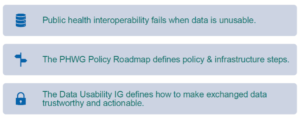
Over the past few years, the Interoperability Matters Data Usability Workgroup has published two Implementation Guides that include guidance for data exchange between healthcare providers and public health agencies, such as:
- Data Provenance & Traceability Across the Care Continuum Public Health Use Cases: Differentiate between original documentation and reconciliation of externally sourced data – A public health organization wishes to leverage provenance to distinguish administered vaccines from a later recording of an externally sourced vaccine in another record. Patient history of vaccinations is sometimes recorded in the official immunization section of the EHR to satisfy gaps in care/CDS but can be done inconsistently or inaccurately. Immunization registries, regional HIEs (as aggregators) and individual EHRs all may share vaccine information, making duplication a bigger problem. The original administration is the most valuable, but the later recording is error prone. Loss of provenance would make reconciliation difficult.
- Effective Use of Codes Across the Care Continuum Public Health Use Cases: USCDI V3 data classes and attribute, externally sourced data, EHR, HIE, Registry — Patient history in the Individual Medical Management System (IMMS) or Vaccine Action Command and Coordination System (VACCS) is sometimes recorded in the official vaccination section of Electronic Health Record (EHR) to satisfy care gaps in the Clinical Decision Support System (CDSS) but may be done inconsistently or inaccurately. Facilities are required to report Healthcare Associated Infections (HAIs) to National Healthcare Safety Network (NHSN) Public Health (state and/or federal requirements).
- Effective Use of Codes Across the Care Continuum Public Health Use Cases: USCDI V3 data classes and attribute, externally sourced data, EHR, HIE, Registry — Patient history in the Individual Medical Management System (IMMS) or Vaccine Action Command and Coordination System (VACCS) is sometimes recorded in the official vaccination section of Electronic Health Record (EHR) to satisfy care gaps in the Clinical Decision Support System (CDSS) but may be done inconsistently or inaccurately. Facilities are required to report Healthcare Associated Infections (HAIs) to National Healthcare Safety Network (NHSN) Public Health (state and/or federal requirements).
- Data Tagging / Searchability Across the Care Continuum Use Cases: Public health searches by C-CDA document titles to only request documents which pertain to certain criteria, such as diagnosis code — From the end use/end user perspective, it is important to know if data pertains to an activity (action) that is in the past, in the present, or in the future. A provider working on a research project searches for a C-CDA document for the diagnosis code relevant to their research. When the document is received, the provider is alerted that there are sections of the document that are marked with privacy tags indicating the patient involved does not consent to their data being used in research. The provider removes this document from their research pool.
- Effective Use of Narrative Across the Care Continuum Use Case: Public Health officials would like to have the capability to query or have data pushed based on a diagnosis/ICD-10 related to TB, HIV or Syphilis. Both narrative and structured elements.
- Laboratory Interoperability – Supporting the Care Continuum: A provider receives lab results into their EHR from a laboratory and is required to report to public health by law using Electronic Case Reporting specifications.
Opportunities for Engagement: The Public Health Community of Practice recently gathered public comment to finalize and release its Public Health Interoperability Policy Roadmap. Data usability is an important underpinning for the roadmap, including standards training and adoption, data quality and harmonization, and interoperability testing.
In recognition of National Public Health Week, the Public Health Community of Practice will host a webinar to introduce the roadmap on Tuesday, April 7 from 2:00 to 4:00pm ET. There is no charge to attend the webinar, however registration is required.
If you are a state or local public health leader interested in building a health data sharing strategy, check out the Public Health Interoperability Policy Roadmap.
If you are a public health leader interested in participating in the Public Health Community of Practice, please contact us InteropMatters@SequoiaProject.org.
If you’d like to participate in the Data Usability Workgroup, please contact us InteropMatters@SequoiaProject.org.